Email: info@touchsh.com
User

Industrial Touch All-in-One PC Empowers Production Line Digitization
2026-10-17 17:28:56
10
Industrial Touch All-in-One PC Empowers Production Line Digitization
[Shanghai, China — October 17, 2026] — Traditional production lines run on paper, clipboards, and tribal knowledge. Operators log counts by hand, supervisors walk the floor to check status, and proble
ms are discovered hours — or days — after they occur. Production line digitization changes all of this: every machine, every process, every product becomes connected, visible, and data-driven.
And at the center of this transformation is the industrial touch all-in-one PC — the edge terminal deployed at every machine and workstation that turns a traditional production line into a digital one. This article explains how.
What Is Production Line Digitization?
Production line digitization means replacing manual, paper-based, and disconnected processes with digital, connected, data-driven ones:
| Traditional Production Line | Digitized Production Line |
|---|---|
| Paper work instructions | Digital, interactive work instructions on screen |
| Manual count logging | Automatic data capture from machines and sensors |
| Walk-the-floor status checks | Real-time dashboards visible everywhere |
| Reactive problem-solving | Predictive alerts and real-time Andon |
| Batch quality inspection | Inline quality monitoring and traceability |
| Monthly production reports | Real-time OEE and production metrics |
| Siloed machine data | Connected data flowing to MES/ERP/cloud |
The industrial touch all-in-one PC is the device that makes this transition possible — it's the digital interface between operators, machines, and enterprise systems.
Five Core Capabilities That Empower Digitization
1. Real-Time Data Acquisition
A digitized line runs on data — and the industrial touch all-in-one PC is where data is collected. It connects to:
- PLCs and controllers via RS232/RS485 (Modbus RTU) or Ethernet (Modbus TCP, EtherNet/IP, PROFINET)
- Sensors and instruments — temperature, pressure, flow, vibration, energy meters
- Vision systems and cameras via Ethernet/USB for quality inspection
- Barcode/RFID scanners via USB/Bluetooth for part and product tracking
- Operator inputs — touchscreen confirmation, task completion, quality logging
Every production event — machine cycle, part produced, defect detected, material consumed — is captured automatically, in real time, with no manual entry.
2. Operator HMI & Digital Work Instructions
The touch all-in-one PC replaces paper SOPs and clipboards with:
- Interactive digital work instructions — step-by-step guidance with images, videos, and animations
- Real-time task display — current work order, target quantity, elapsed time, progress
- Direct machine control — start/stop, parameter adjustment, recipe selection
- Touch-optimized interface — large buttons, clear visuals, designed for gloved operators
- Multi-language support — for diverse workforces
Operators no longer need to interpret paper documents or remember complex procedures — everything is on screen, in real time, in their language.
3. Edge Processing & Real-Time Decisions
Digitization doesn't mean sending everything to the cloud. The industrial touch all-in-one PC processes data at the edge:
- Local data filtering and aggregation — only meaningful data sent upward
- Real-time quality checks — pass/fail decisions in milliseconds
- OEE calculation — availability, performance, quality computed locally
- Adaptive control — machine parameter adjustments based on real-time conditions
- Offline operation — continues working even if network connection fails
This low-latency edge processing is critical for high-speed lines where every millisecond matters.
4. MES / ERP / Cloud Integration
The touch all-in-one PC bridges the shop floor and the enterprise:
- Sends upward: production counts, quality data, OEE metrics, downtime events, material consumption, operator actions
- Receives downward: work orders, recipes, production schedules, quality parameters, configuration updates
- Protocols: OPC UA (modern industrial interoperability), MQTT (lightweight IoT messaging), Modbus (legacy compatibility)
- Dual Ethernet: isolated control network + IT/monitoring network for security and performance
Every production event is synchronized with MES and ERP — no more data silos, no more manual report generation.
5. Digital Visualization & Transparency
Digitization makes operations visible:
- Real-time production dashboards — output, target vs. actual, cycle time, takt time
- OEE monitoring — availability, performance, quality, with drill-down to root causes
- Andon displays — real-time alerts for downtime, quality issues, material shortages
- Quality trends and SPC — statistical process control charts, defect tracking
- Energy monitoring — real-time consumption by machine or line
- Historical trends — compare shifts, days, weeks for continuous improvement
Operators see their progress. Supervisors see bottlenecks. Management sees performance — all in real time, from anywhere.
Digitization Application Scenarios
| Scenario | How Touch All-in-One PC Enables It |
|---|---|
| Smart Production Scheduling | Real-time capacity and status data feeds scheduling systems; work orders pushed to line terminals |
| Quality Traceability | Every part scanned, every process logged, every parameter recorded — full genealogy from raw material to finished product |
| Real-Time OEE Monitoring | Machine data collected continuously; OEE calculated and displayed; downtime categorized automatically |
| Predictive Maintenance | Vibration/temperature/current data collected at edge; anomaly detection alerts maintenance before failure |
| Andon Alerting | Operators trigger alerts via touch; dashboards and stack lights update instantly; response times tracked |
| Paperless Work Instructions | Digital SOPs displayed at workstation; version-controlled, multi-language, with images and video |
| Energy Management | Real-time consumption per machine/line; energy per unit calculated; efficiency opportunities identified |
| Labor Tracking | Operator login/logout via touch/RFID; labor time per order tracked; productivity measured |
Benefits of Production Line Digitization
表格
| Benefit | Typical Impact |
|---|---|
| Increased productivity | 15–30% through reduced downtime, optimized scheduling, and real-time guidance |
| Reduced downtime | 20–40% through predictive maintenance and real-time Andon response |
| Improved quality | 25–50% defect reduction through inline monitoring and digital work instructions |
| Full traceability | 100% product genealogy for recalls, compliance, and continuous improvement |
| Lower labor cost | Reduced manual data entry, paperwork, and supervision time |
| Faster problem resolution | Real-time alerts and root-cause data cut problem-solving time by 50%+ |
| Data-driven improvement | Accurate, real-time data enables continuous improvement based on facts, not guesswork |
| Scalability | Digital infrastructure supports adding lines, products, and analytics without rework |
Senke Industrial Touch All-in-One PCs for Digitization
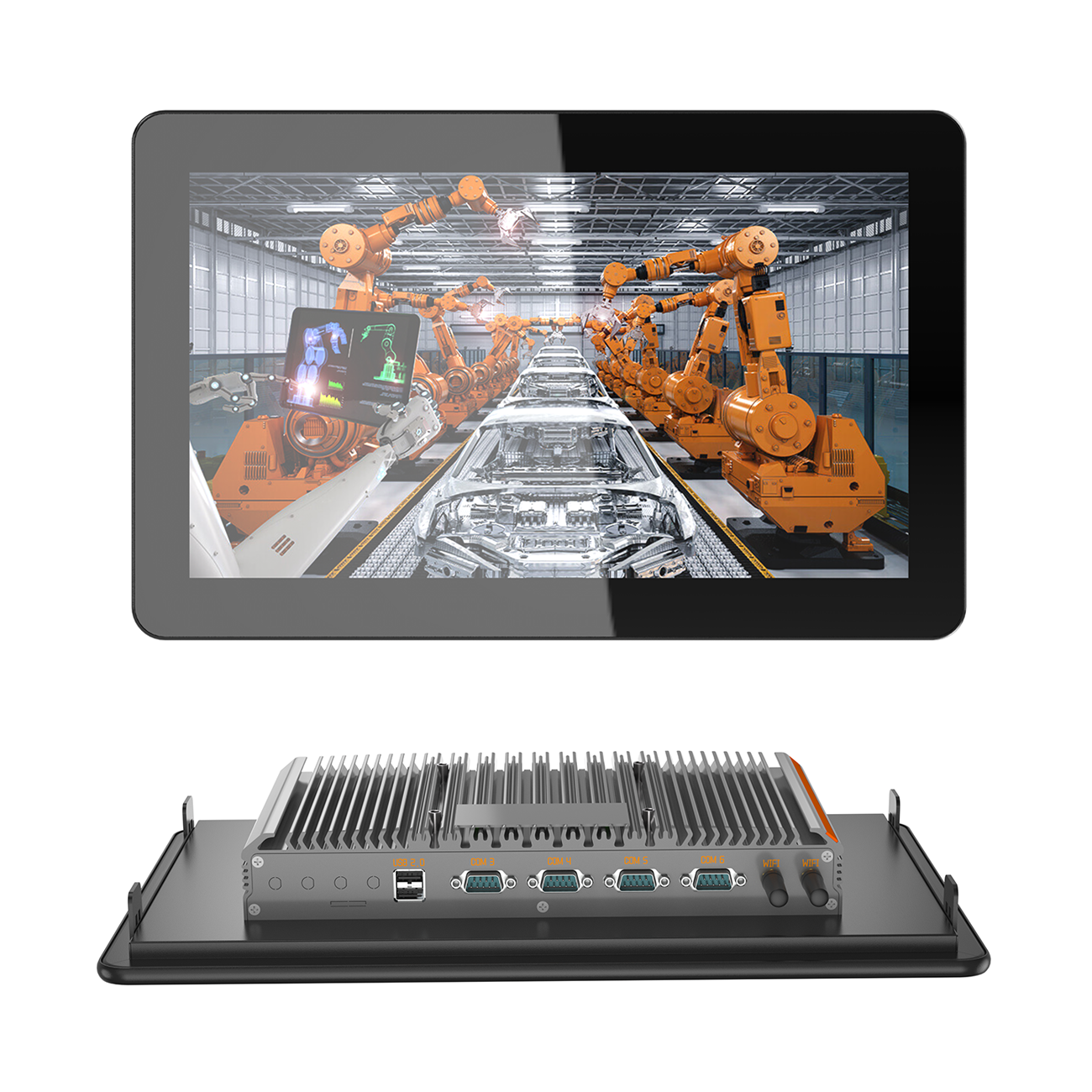
Senke's industrial touch all-in-one PC lineup is engineered to serve as the edge terminal for production line digitization:
- Full size range: 7" to 27" — from compact machine HMI to large line dashboards
- Fanless IP65 construction: zero maintenance, dust/water resistant, 24/7 reliability
- PCAP 10-point multi-touch: glove/wet-finger capable, full-lamination option, anti-glare option
- Rich I/O: RS232/RS485 (1–4), dual Ethernet (PoE option), USB (2–6), GPIO (4-in/4-out), HDMI, CAN option
- Wireless: Wi-Fi, Bluetooth, optional 4G LTE/GPS
- OS: Android 11, Linux, Windows 10/11 IoT, dual-system
- Protocols: Modbus RTU/TCP, OPC UA, MQTT — native support
- Edge processing: ARM quad/octa-core or Intel Celeron — sufficient for local analytics and HMI
- Wide-temperature: -10°C to 60°C standard, ext. -30°C to 80°C
- Reliability: 100,000+ hour MTBF, 7–10 year lifecycle
- Customization: OEM/ODM for branding, I/O, enclosure, software pre-configuration
Conclusion
Production line digitization is no longer optional — it's the difference between competitive, data-driven manufacturing and outdated, paper-based operations. And the industrial touch all-in-one PC is the foundational technology that makes digitization possible: the edge terminal that collects data, enables operator HMI, runs edge analytics, connects to MES/ERP/cloud, and delivers real-time visualization.
For manufacturers embarking on digitization, choosing the right edge terminal means choosing devices that are reliable (fanless, 100,000+ hour MTBF), connected (rich I/O, industrial protocols), flexible (multiple OS, customizable), and long-lasting (7–10 year lifecycle). Senke's industrial touch all-in-one PC lineup delivers exactly that — empowering production line digitization from machine to enterprise.
About Senke Senke is a trusted global provider of industrial display solutions, touch computers, and HMI systems. Senke's industrial touch all-in-one PCs serve as the edge terminals for production line digitization — with fanless IP65 construction, PCAP 10-point multi-touch with glove support, rich industrial I/O (RS232/RS485, dual Ethernet, USB, GPIO), wireless connectivity, multiple OS options (Android/Linux/Windows/dual-system), native Modbus/OPC UA/MQTT protocol support, edge processing capability, and 100,000+ hour MTBF. With a full lineup from 7" to 27" and comprehensive OEM/ODM customization, Senke delivers the reliable, connected, and flexible edge terminals that empower production line digitization — from real-time data acquisition and operator HMI to MES/ERP integration and digital visualization — for manufacturers worldwide.
Contact Senke International Sales Department Email: sales@senke.com Website: www.senke.com
New News
Embedded Industrial PC for Simple Integration
29
2026-10-16
High Protection Industrial Touch Panel PC
38
2026-10-15
Hot Products
Full Screen Digital Advertising Poster
Ultra-thin 4k
10 Inch Windows Rugged Tablet
Android 11,MT8788,4G,64G

Senke Electronic is a manufacture of industrial panel pc, industrial box pc, rugged tablet, kiosk payment and digital display advertising.