Email: info@touchsh.com
User

Fanless Cooling in Industrial All-in-One PCs: Silent, Dustproof, and Long-Lasting
2026-08-28 15:58:59
310
Fanless Cooling in Industrial All-in-One PCs: Silent, Dustproof, and Long-Lasting
[Shanghai, China — August 28, 2026] — In industrial computing, reliability is everything. A single unexpected failure on a production line can cost thousands in lost output, damaged product, and emergency repairs. Among the factors determining industrial PC reliability, cooling technology stands out as critical — and fanless cooling has become the gold standard for modern industrial all-in-one PCs, delivering three decisive advantages: silence, dustproof sealing, and dramatically extended service life.
How Fanless Cooling Works
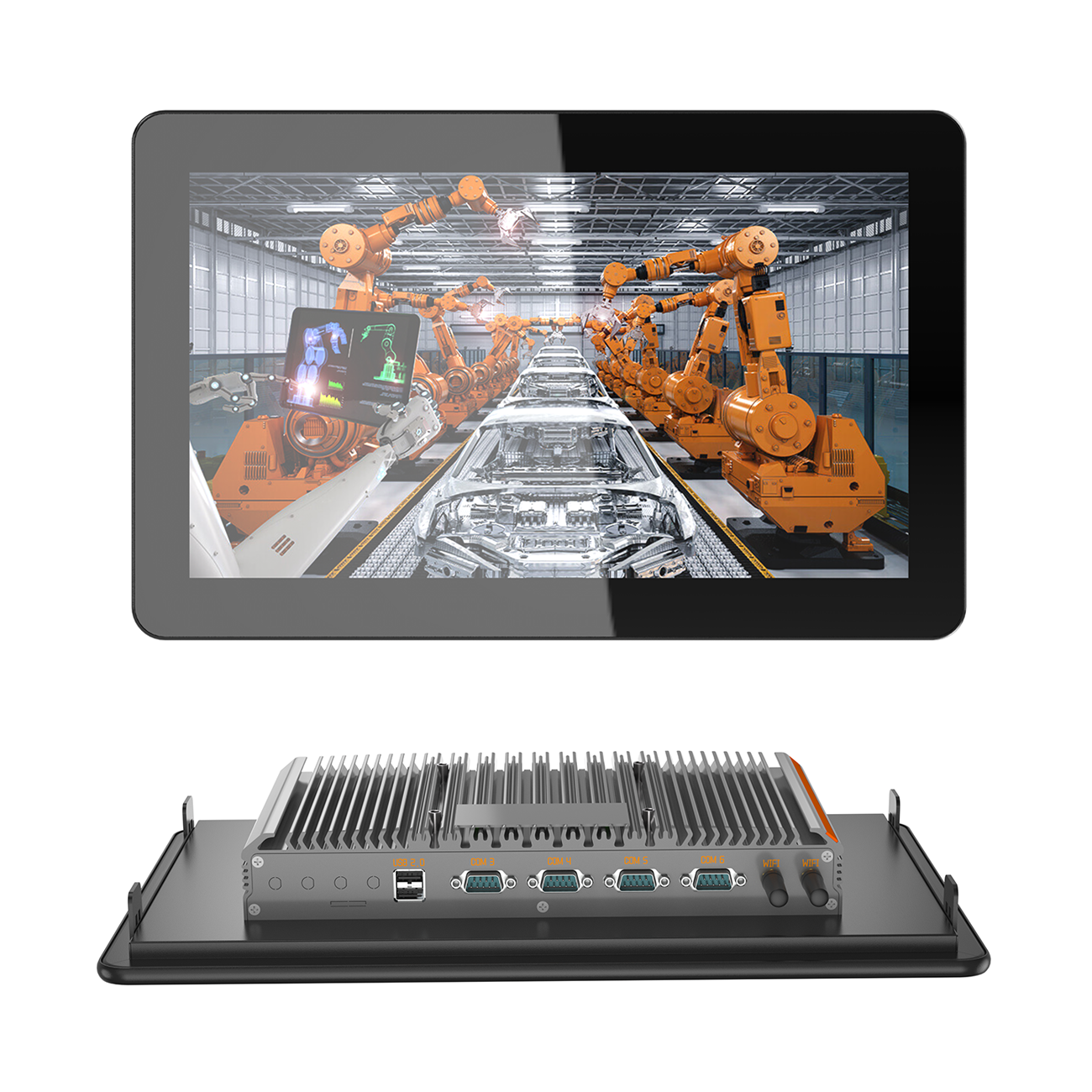
Unlike traditional fan-cooled systems that use spinning fans to force air over heatsinks, fanless industrial PCs use passive thermal dissipation — no moving parts, no ventilation openings. The principle is elegant:
- Heat Pipes — High-efficiency copper heat pipes make direct contact with the CPU and heat-generating components. Inside each pipe, a working fluid evaporates at the hot end, carries heat to the cool end, condenses, and flows back — a continuous self-powered cycle that transfers heat many times faster than solid metal.
- Large Metal Chassis — The heat pipes conduct heat to the aluminum alloy enclosure, which serves as a giant heatsink. The chassis surface — often enhanced with finned structures — dissipates heat through natural convection and radiation.
- Thermal Interface Materials — High-conductivity thermal paste fills microscopic gaps between components and heat pipes, minimizing thermal resistance.
The result: a cooling system with zero moving parts, zero vents, and zero maintenance — engineered for 24/7 operation in the harshest environments.
Advantage 1: Silent Operation
Fans are the primary noise source in industrial PCs. Even industrial-grade fans produce 30–45 dB under normal operation, exceeding 50 dB at high speed. With multiple devices running, noise accumulates quickly.
Fanless systems produce zero noise — critical in:
- Hospitals & Healthcare — patient rooms, operating areas, and quiet laboratories
- Laboratories & Research — precision environments where acoustic interference matters
- Offices & Control Rooms — shared workspaces where cumulative fan noise reduces comfort
- High-End Retail & Hospitality — customer-facing kiosks where silence enhances quality
- Recording Studios & Broadcast — environments where any background noise is unacceptable
Beyond comfort, silent operation eliminates the psychological "something is running" distraction, creating a calmer, more focused work environment.
Advantage 2: Complete Dust & Moisture Sealing
The greatest weakness of fan-cooled PCs is their ventilation openings. To move air, fans require intake and exhaust vents — open invitations for dust, fibers, oil, moisture, and corrosive gases to enter.
Over time, the consequences are severe:
- Dust clogs heatsink fins, reducing thermal efficiency and causing overheating
- Dust coats fan blades, unbalancing them, increasing noise, and shortening bearing life
- Moisture causes corrosion on circuit boards, connectors, and contacts
- Oil and chemical vapors degrade plastic components and insulation
In dusty environments like woodworking, textiles, mining, and cement, fan-cooled PCs may require monthly cleaning — and failure rates remain high. In food and beverage plants, high-pressure washdown makes fan-cooled devices nearly impossible to protect.
Fanless systems solve this fundamentally. With no vents, the entire enclosure can be fully sealed — Senke industrial tablets achieve IP65 front-panel rating (dust-tight, water-jet resistant), with some models reaching IP67 (protected against temporary immersion). This means:
- Zero dust ingress — no internal cleaning ever needed
- Water & oil resistance — safe for washdown environments and oily factory floors
- Corrosion protection — sealed electronics last far longer in humid or chemical environments
- No filters to replace — eliminating a recurring maintenance task and cost
For industries where dust, moisture, and washdown are daily realities — food & beverage, pharmaceutical, chemical, mining, agriculture, outdoor kiosks, and car washes — fanless isn't just a feature; it's a necessity.
Advantage 3: Dramatically Extended Service Life
Every moving part is a potential failure point. In fan-cooled PCs, the fan is the single most likely component to fail — and when it does, the result is often cascading overheating damage to the CPU, motherboard, and storage.
Industrial fan lifespan is typically rated at 30,000–50,000 hours MTBF. In 24/7 continuous operation, that's only 3.4–5.7 years before fan failure becomes statistically likely.
Fanless systems have no moving parts at all. With nothing to wear out, their MTBF exceeds 100,000 hours — over 11 years of continuous 24/7 operation. This is transformative:
- Lower total cost of ownership — no fan replacements, no emergency service calls, no downtime losses
- Longer deployment cycles — devices remain in service for 7–10+ years instead of 3–5
- Predictable reliability — no sudden fan failures, no thermal emergencies
- Reduced spare parts inventory — no need to stock replacement fans or filter kits
- Simplified maintenance — zero internal maintenance required; "install and forget" becomes reality
For mission-critical applications where downtime is expensive — manufacturing lines, energy infrastructure, transportation systems, healthcare equipment, and remote unmanned stations — the extended service life of fanless systems directly translates to lower risk and lower cost over the device's lifetime.
The Senke Fanless Advantage
Senke's entire industrial tablet and panel PC lineup — from 7" to 27" — employs fanless passive cooling as standard architecture. Every Senke device features:
- High-Efficiency Heat Pipe System — optimized thermal layout ensuring even heat distribution
- All-Metal Aluminum Alloy Enclosure — serves as both structural support and large-area heatsink, with corrosion-resistant anodized finish
- IP65 Front Panel — fully sealed against dust, water spray, and oil
- Wide Temperature Operation — stable performance from -10°C to 60°C (some models extend to -20°C)
- Zero Maintenance Design — no fans, no vents, no filters
- 5+ Year Product Availability — long-term supply stability matching the long service life of fanless devices
Whether deployed on a dusty factory floor, a washdown food-processing line, a quiet hospital ward, an outdoor solar-powered kiosk, or a remote unmanned monitoring station, Senke fanless industrial PCs deliver the silent, dustproof, long-lasting reliability that industrial environments demand.
Conclusion
Fanless cooling technology represents more than an engineering choice — it is a fundamental shift in how industrial PCs achieve reliability. By eliminating fans and vents, fanless systems deliver three transformative benefits that fan-cooled devices cannot match:
- Silence — zero noise for noise-sensitive environments
- Dustproof Sealing — fully sealed IP65 enclosures that survive dust, water, oil, and washdown
- Long Life — 100,000+ hour MTBF, zero maintenance, and 10+ year service life
As industrial operations demand ever-higher uptime and ever-lower maintenance costs, fanless cooling has transitioned from a premium option to the standard for reliable industrial computing. For any deployment where silence, environmental resistance, and long-term reliability matter, fanless is the clear choice — and Senke's full fanless lineup delivers these benefits across every screen size and application.
About Senke Senke is a trusted global provider of industrial display solutions, touch computers, and HMI systems. With a full 7"–27" fanless product lineup, IP65 industrial-grade reliability, and deep customization capabilities, Senke serves manufacturing, automotive, food & beverage, pharmaceutical, logistics, retail, healthcare, and energy industries worldwide.
New News
Multi COM Industrial All-in-One PC for PLC Connection
26
2026-10-23
Multi-size Industrial All-in-One PCs Available in Stock
67
2026-10-20
Hot Products
Full Screen Digital Advertising Poster
Ultra-thin 4k
10 Inch Windows Rugged Tablet
Android 11,MT8788,4G,64G

Senke Electronic is a manufacture of industrial panel pc, industrial box pc, rugged tablet, kiosk payment and digital display advertising.