Email: info@touchsh.com
User

Fanless Industrial Panel PCs Become Mainstream Development Direction for Industrial Automation
2026-09-23 18:13:53
151
Fanless Industrial Panel PCs Become Mainstream Development Direction for Industrial Automation
[Shanghai, China — September 23, 2026] — A decade ago, fanless industrial panel PCs were a niche option — specified only for the dustiest, dirtiest, or most maintenance-critical applications. Today, they are the mainstream choice for industrial automation. Specify a new industrial panel PC for a machine HMI, production line, or factory control system, and chances are it will be fanless.
This article examines why fanless design has become the standard, what drove the transition, and what it means for industrial automation.
The Fan Problem: Why Fans Don't Belong in Industrial PCs
To understand why fanless has become mainstream, you first have to understand why fans are problematic in industrial environments:
1. Fans Are the #1 Failure Point
A cooling fan is a high-speed rotating mechanical device with bearings that wear out. In industrial conditions:
- 24/7 operation means the fan rotates for 8,000+ hours per year
- High temperatures accelerate bearing lubricant degradation
- Dust and oil contamination further degrade bearings
- Vibration from machinery accelerates wear
- Typical fan lifespan in industrial conditions: 1–3 years (vs. 5+ years in clean offices)
When a fan fails, the system overheats within minutes — causing thermal shutdown, data loss, or permanent hardware damage.
2. Fans Require Vents — Which Break Sealing
A fan needs ventilation openings to draw in cool air and exhaust hot air. These openings are a direct pathway for:
- Dust — cement, metal, wood, food powder enters and clogs internals
- Water — washdown spray, rain, condensation enters and causes short circuits
- Oil and chemicals — oil mist, cleaning agents, corrosive fumes enter and degrade components
This is why fan-cooled industrial PCs typically only achieve IP20–IP40 protection. They simply cannot be sealed tightly enough to cool effectively. In washdown, dusty, or outdoor environments, this is a fatal limitation.
3. Fans Require Maintenance
Fan-cooled industrial PCs need regular maintenance:
- Monthly filter cleaning or replacement
- Quarterly fan inspection and replacement
- Internal dust removal every 6–12 months
- Thermal paste replacement every 1–2 years
Each maintenance visit costs labor, requires equipment downtime, and introduces risk of damage during service. In a 24/7 factory, taking a machine offline for fan maintenance is costly and disruptive.
4. Fans Generate Noise
Fan noise may seem minor, but in control rooms, clean rooms, and office-adjacent industrial areas, it adds up. Multiple fan-cooled PCs can create significant background noise — contributing to operator fatigue and reducing the professional appearance of control rooms.
What Changed: The Technology Enabling Fanless Mainstream
Fanless design wasn't always practical for industrial automation. Three technology advances made it mainstream:
1. Low-Power Processors
The biggest enabler. Modern ARM and Intel Celeron processors deliver sufficient performance for HMI and control applications at very low power:
- ARM Cortex-A series: 5–15W TDP — enough for Android/Linux HMI, data logging, and edge processing
- Intel Celeron J/N series: 10–25W TDP — enough for Windows HMI, light multi-tasking, and SCADA clients
- Intel Core i3 (low-power): 15–28W TDP — for more demanding Windows applications
At these power levels, passive cooling is feasible — no fan needed. A decade ago, industrial PCs used 65W+ desktop processors that required aggressive fan cooling. Today, most HMI and control applications run perfectly on 15–25W processors.
2. Advanced Thermal Design
Fanless cooling has improved dramatically:
- Copper heat pipes — transfer heat 10–100x more efficiently than solid copper, rapidly moving heat from the CPU to the enclosure
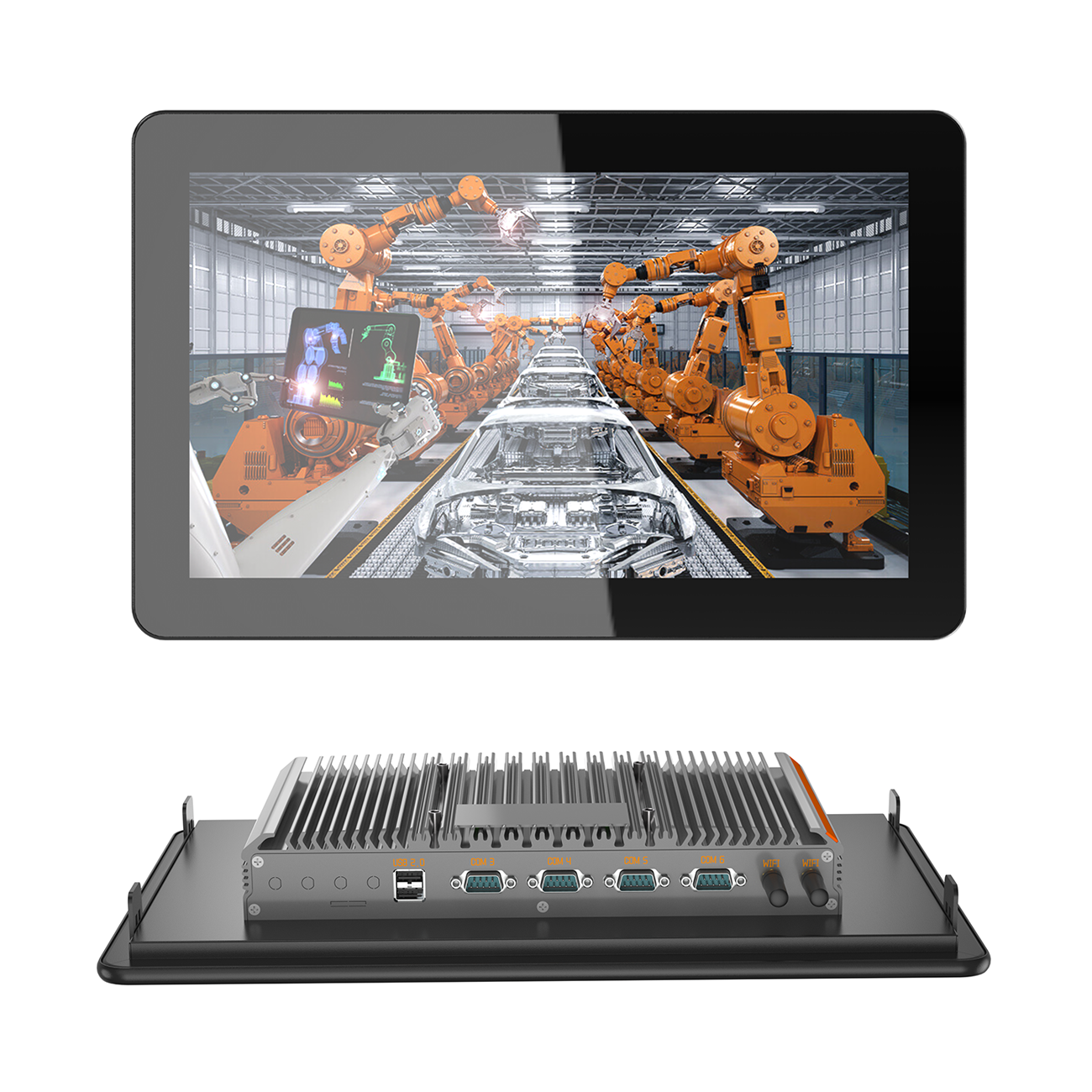
- Thermally conductive aluminum enclosures — the entire enclosure acts as a large external heatsink (500–1500 cm² surface area)
- Thermal interface materials — high-quality thermal grease, phase-change pads, and conductive epoxy minimize thermal resistance
- Fin optimization — finned structures on enclosure backs enhance natural convection
- CFD simulation — computational fluid dynamics is used to optimize heat flow and enclosure design
These advances mean fanless systems can now handle 25–35W processors reliably — covering the vast majority of industrial HMI and control applications.
3. Solid-State Storage
The elimination of spinning hard disk drives (HDDs) in favor of solid-state eMMC and SSD storage removed another heat source and another moving part. Modern industrial panel PCs use:
- eMMC (standard) — low power, no moving parts, sufficient for HMI applications
- SATA SSD / NVMe SSD (optional) — higher capacity, still solid-state
With no HDD and no fan, the industrial panel PC has zero moving parts — eliminating the two most common failure points.
Why Fanless Is Now the Default
With the technology barriers removed, fanless design has become the default specification for industrial automation because it delivers clear, measurable advantages:
| Advantage | Impact |
|---|---|
| Zero moving parts | Eliminates the #1 failure point (fan bearing wear) |
| No ventilation openings | Enables full IP65/IP67 dust/water sealing |
| Zero maintenance | No fan cleaning, filter replacement, or fan replacement |
| Longer service life | 7–10+ years vs. 3–5 years for fan-cooled PCs in harsh environments |
| Silent operation | No fan noise — ideal for control rooms, clean rooms, public areas |
| Better dust resistance | No vents = no dust ingress path |
| Better vibration resistance | No fan bearings to fail under vibration |
| Lower total cost | No maintenance labor, no replacement parts, less downtime |
For industrial automation — where reliability, low maintenance, and environmental sealing are paramount — fanless isn't just an option. It's the logical default.
The Transition Across Applications
The shift from fan-cooled to fanless is happening across every industrial automation application:
Machine HMI
Fanless is now standard. Machine-mounted HMI terminals face heat, vibration, oil, and 24/7 operation — exactly where fans fail fastest. New machine designs almost universally specify fanless panel PCs.
MES & Production Terminals
Fanless is dominant. Production floor terminals run continuously in dusty, busy environments. Fanless design eliminates the maintenance burden and ensures reliable operation across shifts.
Food & Beverage / Pharmaceutical
Fanless is mandatory. Washdown environments require IP65/IP67 sealing — impossible with fan vents. Fanless, fully-sealed panel PCs are the only viable option.
Mining, Cement & Heavy Industry
Fanless is essential. Extreme dust clogs fans within weeks. Fanless, ventless, IP65-sealed panel PCs are the only reliable choice.
Outdoor & Smart City
Fanless is required. Outdoor installations need fully sealed enclosures to survive rain, snow, and dust. Fanless design enables the IP65/IP67 sealing that outdoor computing requires.
Energy & Utilities
Fanless is preferred. Remote substations, wind farms, and solar installations need zero-maintenance, high-reliability computing. Fanless design reduces service visits to remote locations.
Control Rooms & Clean Rooms
Fanless is growing. Silent operation and improved reliability make fanless PCs attractive in control rooms and clean rooms where noise and contamination are concerns.
What About High-Performance Applications?
Fanless design covers the vast majority of industrial HMI and control applications — but what about applications that genuinely need high-performance processing (heavy multi-tasking, complex visualization, video processing, AI inference at the edge)?
For these applications, options include:
- Higher-performance fanless systems with larger enclosures and more aggressive thermal design (handling 35–50W)
- Hybrid approaches — a fanless HMI terminal for operator interface, connected to a separate high-performance edge computer (which may use fan cooling in a controlled environment)
- Liquid cooling — emerging for very high-performance industrial edge computing
But for 90%+ of industrial automation applications — machine HMI, MES terminals, production monitoring, data acquisition, basic edge processing — fanless is more than sufficient and is the right choice.
The Future: Fanless as the Foundation of Smart Factory Computing
As industrial automation evolves toward smart manufacturing, Industry 4.0, and the IIoT, the role of the industrial panel PC is expanding — from simple HMI display to edge computing terminal. And as this role expands, the case for fanless design only grows stronger:
- Edge terminals run 24/7 — reliability is paramount
- Edge terminals are deployed everywhere — from clean control rooms to dusty production floors to remote outdoor sites
- Edge terminals need long lifecycles — 7–10 years to match equipment service life
- Edge terminals need zero maintenance — you can't service thousands of distributed edge devices regularly
Fanless design — with zero moving parts, full sealing, zero maintenance, and long service life — is the foundation of reliable edge computing for the smart factory era.
How Senke Leads in Fanless Industrial Computing
Every Senke industrial panel PC is fanless by design — across the entire 7" to 27" lineup:
- YPC-A Ultra-Thin — slim fanless design for machine mounting
- YPC-WD Dustproof — fully-sealed IP65 all-around, fanless ventless for the dustiest environments
- YPC-JD Rack-Mount — fanless rack form for control rooms
- YPC-AD Andon — fanless with integrated light tower for production lines
- YPC-MX Full-Lamination — fanless with premium optical bonding
All Senke fanless models feature:
- High-efficiency copper heat pipes + thermally conductive aluminum enclosure
- Low-power ARM or Intel Celeron processors (5–25W TDP)
- Solid-state eMMC/SSD storage (zero moving parts)
- IP65 front panel (IP67 fully-sealed option on YPC-WD)
- Wide-temperature operation (-10°C to 60°C standard, ext. -30°C to 80°C)
- Capacitive multi-touch with gloved/wet-finger support
- Rich industrial I/O (RS232/RS485, Ethernet, USB, GPIO, optional 4G)
- 100,000+ hour MTBF
- 7–10 year product lifecycle commitment
- Comprehensive OEM/ODM customization
Conclusion
Fanless industrial panel PCs have completed their transition from niche option to mainstream standard. Driven by the inherent reliability problems of cooling fans, advances in low-power processors and thermal design, and the demanding requirements of 24/7 industrial automation, fanless design is now the default specification for new industrial computing projects.
The advantages are clear and compelling: zero moving parts, full environmental sealing, zero maintenance, longer service life, silent operation, and lower total cost of ownership. For industrial automation — where downtime is costly and maintenance is disruptive — fanless isn't just a feature. It's the foundation of reliable industrial computing.
As smart manufacturing and edge computing continue to expand, the demand for fanless industrial panel PCs will only grow. The future of industrial automation is fanless — and that future is already here.
About Senke Senke is a trusted global provider of industrial display solutions, touch computers, and HMI systems. Every Senke industrial panel PC is fanless by design — no fan, no vents, no moving parts — combining high-efficiency copper heat pipes, thermally conductive aluminum enclosures, low-power processors, and solid-state storage for maximum reliability. With a full lineup from 7" to 27", IP65/IP67 protection, wide-temperature operation, rich I/O, and 7–10 year lifecycle commitment, Senke delivers fanless industrial computing engineered for the harshest environments and the smart factory era.
Contact Senke International Sales Department Email: sales@senke.com Website: www.senke.com
New News
Hot Products

Full Screen Digital Advertising Poster
Ultra-thin 4k
10 Inch Windows Rugged Tablet
Android 11,MT8788,4G,64G

Senke Electronic is a manufacture of industrial panel pc, industrial box pc, rugged tablet, kiosk payment and digital display advertising.